
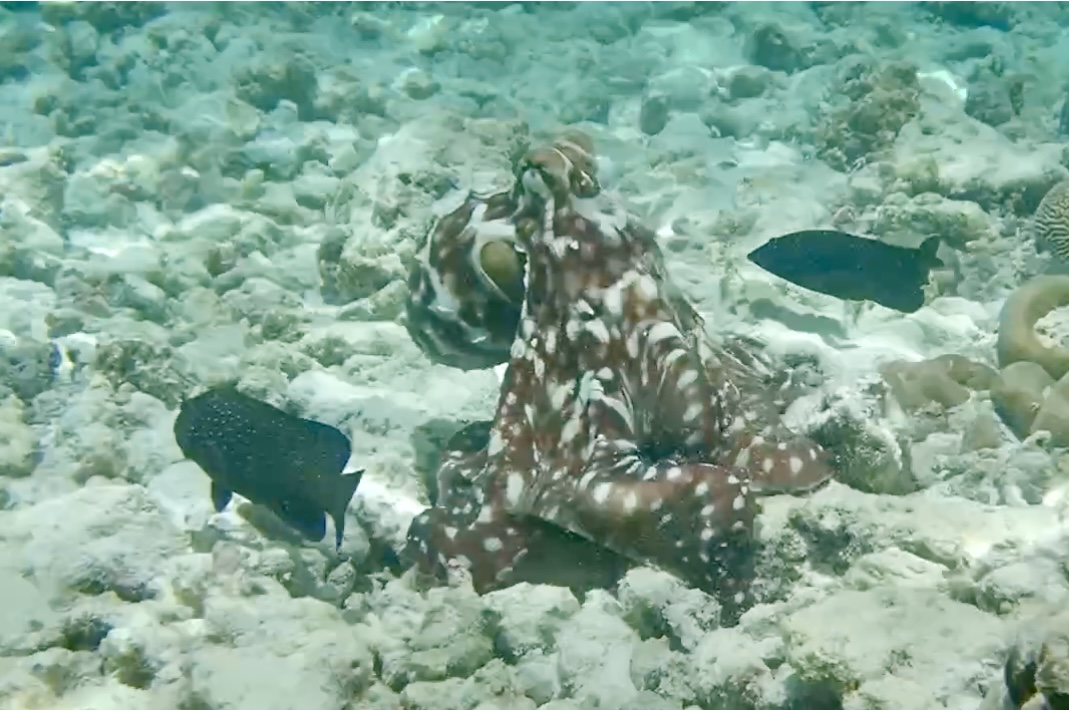
As I snorkeled in the pristine blue waters of the Maldives, I was able to witness one of the most incredible creatures in the ocean–the octopus. Whenever I snorkeled with them, I felt I was encountering an alien–an animal with unearthly abilities and incredible intelligence. The creature would shape shift and use its various arms to multitask. Then, it would crawl across the rocks and occasionally propel itself away from inquisitive snorkelers such as me. But what most struck me was its ability to change colors instantaneously to match its environment. At one moment, it would display a bright red hue; the next, I would lose track of it, only to find it camouflaging against the sand. Red, then white, then a mix of both! It most likely won’t surprise you that this creature has inspired next-generation biomimicry technologies and has given humans insights into the nature of consciousness.
The octopus has inspired three main engineering domains: dynamic materials, soft computing, and physical grasping materials. Engineers have found ways to create 3D camouflage skins which could be used to make stealth fabrics to provide camouflage across shifting terrains. Octopuses change color and texture using specialized nerve cells and tiny muscles controlled directly by their nervous system. This system consists of three layers in their skin: chromatophores (top layer) iridophores (middle), and leucophores (deep layer). Chromatophores are responsible for color control; octopuses expand and contract elastic pigment sacs to alter their skin patterns, and they use a hydrostatic skeleton to push fluid into areas of their skin to create “bumps” (papillae). Synthetic materials have utilized this design by creating stretchable polymer sheets embedded with fluid-filled or elctrochemically active microcavities.
Traditional robots rely on rigid metal joints and heavy processors to calculate movement. For an octopus, its skin and muscles are naturally compliant (flexible), so the octopus doesn’t need to calculate the exact shape of an object to grip it. It utilizes decentralized logic. Essentially, its arm deforms around the object, achieving a perfect grip through physics (reducing the processing load on the main computer). This technology can be used to create medical endoscopes, which can navigate safely through the human body, bending gently around organs without causing damage.
Lastly, industrial suction cups struggle on rough or wet surfaces due to air leakage. Octopus suckers solve this problem through a dual-chambered muscle structure (utilizing the rim and deeper chamber of the sucker). Modern grippers combine these soft cups with integrated sensors. When a cup touches a surface, the sensor detects physical contact which then signals the cup to engage. This idea has inspired deep sea drones equipped with completely soft limbs that crawl, swim, and hold objects.
It certainly seems scientists are “well-armed” with new ideas based on the octopus!





Leave a Reply