
Alright, I know what you’re thinking: “I must have misread this; what the heck is blood sweat? That sounds nasty!” Well, it’s true! The phenomenon of hippopotamus “blood sweat” is one of nature’s most multi-functional chemical defense mechanisms, and it is inspiring the future of skincare!
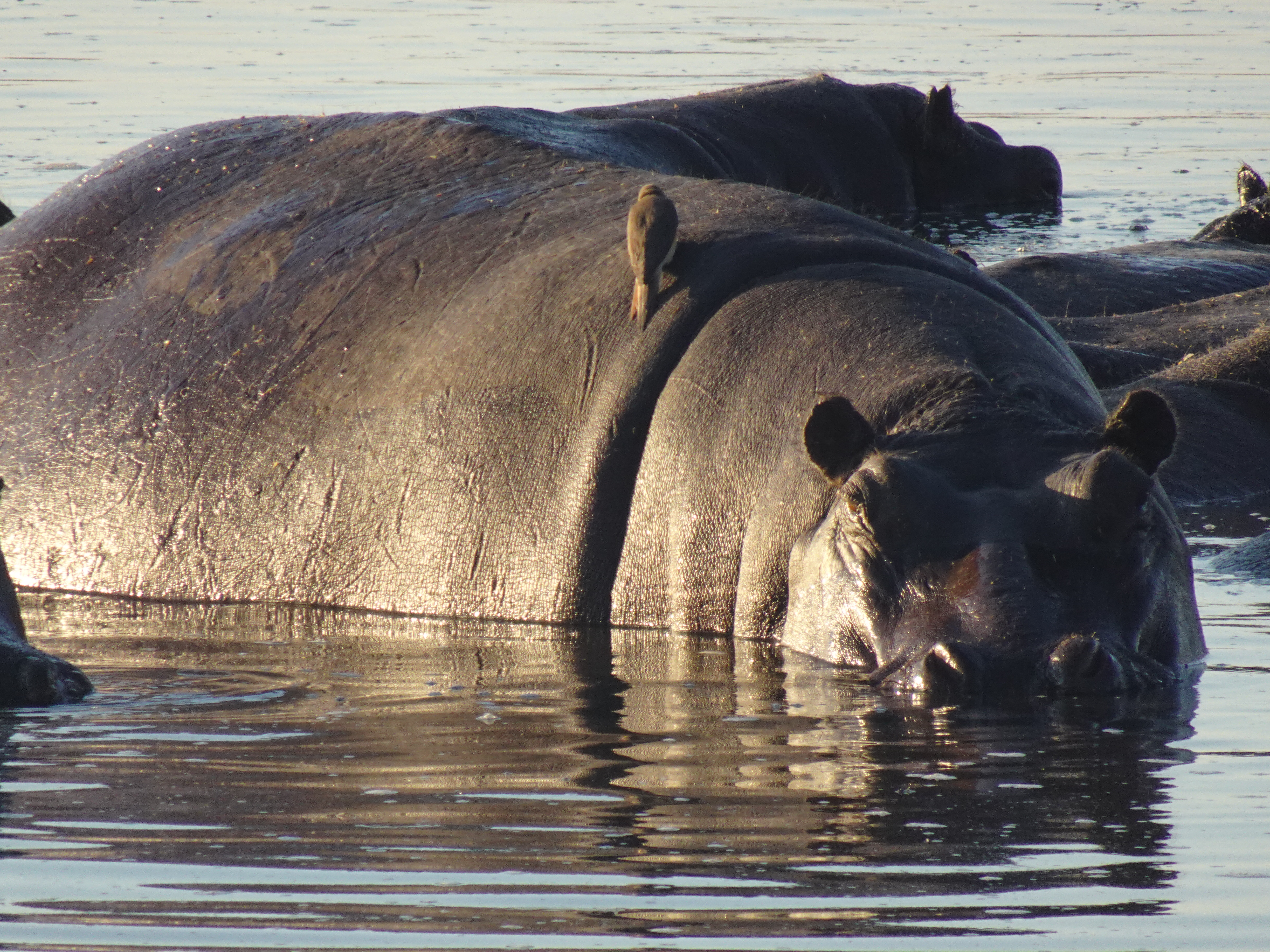
I photographed this big hippo in Botswana under the intense afternoon sun. Wouldn’t you think that since hippos are always in the hot savanna sun, they must get severe sunburns? Nah. Nature had another trick up its sleeve. Despite having hide up to two inches thick, a hippo’s skin is highly sensitive, hairless, and prone to severe drying and sunburn. Because they spend their days baking on African riverbanks and wading through highly contaminated, bacteria-rich waters (eww), they evolved a subdermal glandular system that secretes an all-in-one protective coating. If a hippo were to advertise this product, it would probably say something like this (in a very gruff voice), “This amazing skincare product is a 4-in-1 triple shield mechanism! It acts as a broad-spectrum sunblock and a potent antiseptic and antibiotic, yet it also is responsible for microscopic light scattering and waterproofing and hydration.” Who knew hippos were such good advertisers?
So what exactly is this magical substance? The secretion is completely colorless when it first leaves the glands. Within minutes of reacting with oxygen in the air, it oxidizes and turns brilliant red and then turns brown. A team of Japanese researchers famously isolated the two unstable, highly acidic compounds responsible for this magic: hipposudoric acid and norhipposudoric acid. Once these compounds mix with the thick, mucus-like liquid on the hippo’s skin, they create a durable layer that functions across the 4 distinct vectors described earlier. The hippo’s combined pigments absorb electromagnetic radiation across a massive spectrum (200 to 600 nm), effectively acting as both a chemical sunscreen and a physical sunblock. Also, hipposudoric acid acts as a powerful antibiotic, significantly inhibiting the growth of severe, pathogenic bacteria like Pseudomonas aeruginosa. The secretion dries into a complex crystalline layout, and this structure creates a non-absorbing light-scattering effect, bouncing incoming solar energy away from the body before it can penetrate the dermis. Finally, the mucus traps moisture beneath it so the skin doesn’t crack in the dry desert air (it also functions as a hydrophobic water repellent, keeping the skin from getting completely waterlogged).
Chemical engineers and pharmaceutical companies are deeply investing in synthesizing analogues of these pigments for human use. These include coral reef-safe all-in-one sunscreens. Commercial chemical sunscreens can cause massive coral bleaching. A synthetic sunscreen modeled on hipposudoric acid would be biodegradable and non-toxic to marine life. Also, by mimicking the antibiotic and moisture-trapping properties of the hippo’s mucus, medical researchers aim to create advanced gels for severe burn victims or surgical incisions.
Current research is focused on engineering a stable, synthetic version of the hippo’s “blood sweat” that retains its magical properties without breaking down. This process will certainly take blood, sweat, and tears (see what I did there?), but it has the possibility of having a huge impact on skincare as we know it.




Leave a Reply